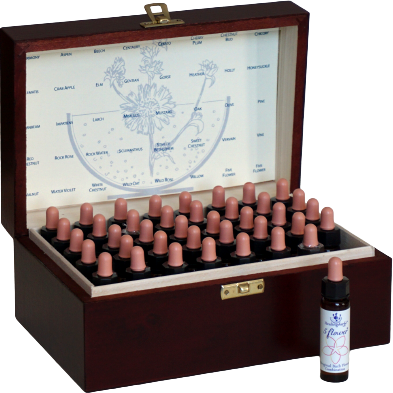
To
purchase Bach Flower Remedies or books from this site, click
here.
Dr Edward Bach (1886-1936)
Edward Bach was born in 1886 near
Birmingham, England. He was aware at an early age of the subtle qualities or
"energies" in the living world around him.
His natural sensitivity to nature and
to the suffering in his fellow humanity led him to a career in medicine.
He trained in medicine at the University College Hospital in London and worked
as a House Surgeon there. He worked in general practice, having a set of
consulting rooms in Harley Street and also conducted research as a
bacteriologist and pathologist, producing a set of homœopathic remedies
known as the Bach bowel nosodes, which are still taught and used in homœopathy today.
Bach joined the London Homœopathic Hospital in 1919.
Bach’s
interest in homœopathy was kindled by a shared belief in the holistic approach
of treating the person as a mental/emotional/physical whole and the disease as
an expression of disequilibrium of the whole. Orthodox medicine, on the other
hand, targeted the disease in isolation, which he instinctively felt was not
addressing the core of the problem, but only the resultant pathology.
Homœopathy,
though he felt a kinship with it, relied on a tremendous variety of substances
including products of disease, and his own idealism and instinct, as well as his
years of experience with healing, led him towards living nature as a source for
curative substances.
A primary
tenet of his principles was the importance of emotional disequilibrium as a
primary cause for susceptibility to illness, as well as being a source of
“dis-ease” in itself. Bach can be seen to be one of the pioneers in the
treatment of psychosomatic illness.
While
maintaining his medical practice, in 1928 he spent much of his spare time
researching plants and herbs and it was during this period that he developed the
first three flower remedies that he would work with – Impatiens, Mimulus and
Clematis. His familiarity with homœopathic provings (testing
the curative properties of substances) and his sensitivity to the subtle
qualities of plants suggested to him the type of personality it could bring
relief to. He found that by prescribing based on the emotional characteristics
of the patient he was able to get results he had never seen before, results
which showed that the whole person was being brought into a state of greater
health. This so impressed him as a healer that he concentrated on flower remedy
treatment and stopped using conventional medicine.
In 1930 he
gave up his lucrative practice to concentrate on the development of this
newfound system of therapy. He left London and his travels took him to Wales
and to the English countryside to search out those plants that would provide a
battery of medicines, which would treat the primary states of dysfunction in the
human psyche. By 1932 he had discovered the first 12 of these, and published
the fruits of his work in Twelve Great Remedies in February 1933. Bach
began to promote them to the medical community, who, schooled in orthodoxy, were
slow to respond. He then promoted using newspaper advertising, which brought
him favourable response from the public, but strong disapproval from the General
Medical Council.
By 1934, he
had developed 19 of the eventual 38 flower remedies and it was in this year that
he moved to Mount Vernon in Oxfordshire, where he developed the remaining 19. In
this year he also published the second edition of his work, this time entitled:
The Twelve healers & Seven Helpers.
In the summer
of 1936, Bach wrote the third edition, The Twelve Healers and Other Remedies,
which included all 38 of the flower remedies which still bear his name. It was in this
year, on his 50th birthday, that he gave his first (and last) public
lecture on the fruits of his life’s work. Shortly following this, as if having
completed his life’s task, his health failed and he died in his sleep on 27th
November 1936.
During his
last few years, Dr Bach had trained three assistants in the art of collecting
and preparing the flower remedies, and the work of producing and promoting their
use continues. Currently the flower remedies are being produced according to
Bach’s methods by two independent organizations in the United Kingdom.
Production still goes on in Mount Vernon at the Bach Flower Centre, and the same
remedies are being produced by Healing Herbs in Hereford. (The 38 flower
remedies are available on-line through this website.)
The addresses
are:
The Dr Edward
Bach Centre
Mount Vernon, Bakers Lane
Sotwell, Oxon, OX10 0PZ, UK
Healing Herbs
Ltd.
P.O. Box 65
Hereford, HR2 0UW
(The flower images used on
this page are copyrighted material and have been used with the express
permission of Healingherbs Ltd.)
To
purchase Bach Flower Remedies or books from this site,
click
here,
or click on any of
the Bach Flower or book images on this page.
Return to top of page